
Evidence Post #1 2025/26 School Year
Post 1: Gathering Evidence and Making a Plan
Focus #1: Supporting students to develop stronger reading proficiency and make meaningful connections to text and the world around them.
What targeted actions did we take to address our school’s learning focus?
At our First Professional Day in September, all staff were introduced to the Richmond Formative Reading Assessment Tool (RFRA). Guided by our Teacher Consultant, Carolyn Russo, teachers learned how to administer the reading assessment, and considered how the information they collected could guide their reading instruction this year. All grade one to seven teachers administered the reading assessment in October of this year.
What gap or problem do these actions aim to address? Why was this particular strategy/action chosen?
From our report card data we knew that 58 percent of our students were Proficient or Extending in English Language Arts last year. What we didn’t know was how proficient they were in the many skills needed to be confident, capable readers. The Richmond Formative Reading Assessment allowed us to assess fluency, decoding, retelling and summarizing, responding to text, predicting, making personal connections, inferencing and questioning.
Based on quantitative and qualitative data (including feedback from scanning), how effectively has this strategy addressed the identified gap or problem?
At our November Staff meeting, teachers reviewed the reading assessments in grade groups and looked for common themes. They recorded their observations on a whiteboard app. It was evident that one main focus area that teachers identified was Making Connections.
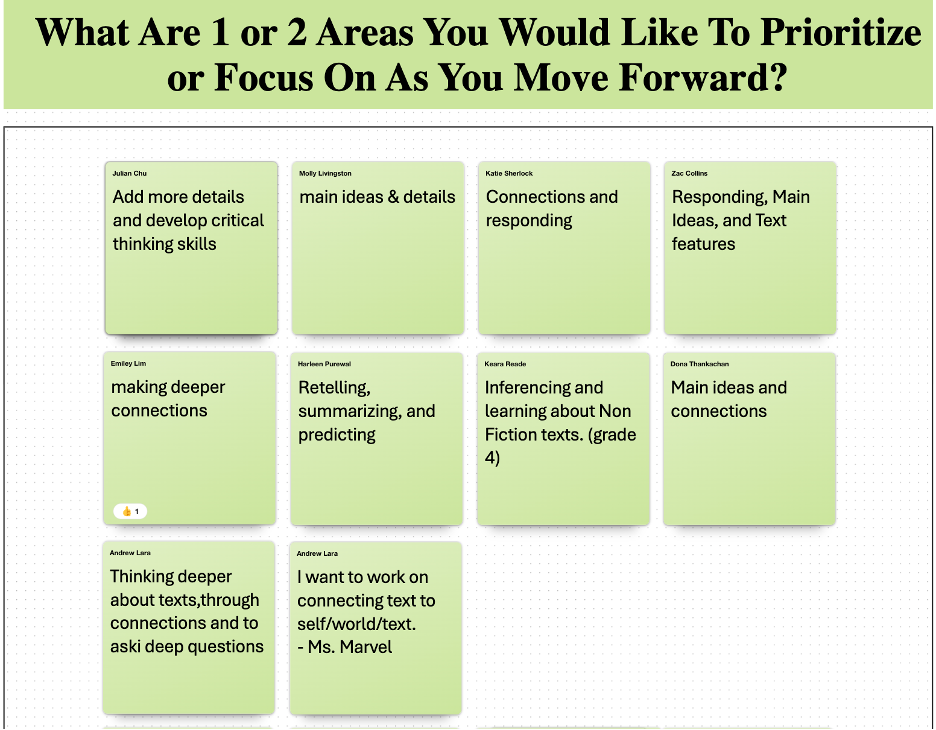
When we looked at “Making Connections” across all grades we saw that seventy percent of our students in grades 1-7 were emerging or developing in the ability to make connections. (See attachment for grade level data)
How will we move forward accordingly? What adjustments do we need to make if we have or have not achieved our goals?
At our next staff meeting we will share the data and create a plan to focus our instruction and resources on teaching our students to make connections. This may include collaboration time to explore strategies to teach making connections, purchasing resources, and additional professional development for our teachers. In addition, we will continue to examine the reading materials available to our students in our library to ensure we have a collection that represents the many cultures and experiences of our students, so that they can feel and make connections to what they are reading.
Inquiry Question #2:
How can we support students and staff to strengthen a positive and safe school culture?
What targeted actions did we take to address our school’s learning focus?
In September and October our Professional Development Committee met with the District Social Responsibility Team to explore the ways in which we can move forward with Social Responsibility in our school. After a “temperature check” with our staff, it was determined that Social Responsibility was an area that staff wanted to explore further. At our November Professional Development Day we had a whole day of brainstorming and learning about Social Responsibility.
What gap or problem do these actions aim to address? Why was this particular strategy/action chosen?
Staff have observed a growing need to further develop students’ self-regulation, social-emotional skills and social responsibility—both in the classroom and on the playground. Currie does have a model and framework for Social Responsibility already- “Currie Cares” , but with many staff changes over the last two years it has become less of a focus and it needs revitalizing.
Based on quantitative and qualitative data (including feedback from scanning), how effectively has this strategy addressed the identified gap or problem?
We are just getting (re)started, however the energy and cohesiveness of our staff at our last Professional Development Day was inspiring. Staff had the opportunity to have a “messy brainstorm” of the challenges that we are seeing.
Here are some of the responses:
“Lack of resilience and stamina…”
“Lack of social skills and how to be a good friend…”
“Running, I mean sprinting! in the halls…”
“Not listening to, or respecting adults…”
“Lack of problem solving skills…
This allowed staff to “get it all out” and then it was time to reframe the questions to “What behaviours do we want to see in our spaces?”
How will we move forward accordingly? What adjustments do we need to make if we have or have not achieved our goals?
We have taken the momentum from our Professional Day and created a Social Responsibility committee of over 10 members, comprised of teachers of all grade levels and EAs. Our committee will examine Our “Currie Cares” framework and structures to develop a shared language that will be supported by classroom and school wide routines and initiatives.
Attachments
Updated:
Friday, December 19, 2025